
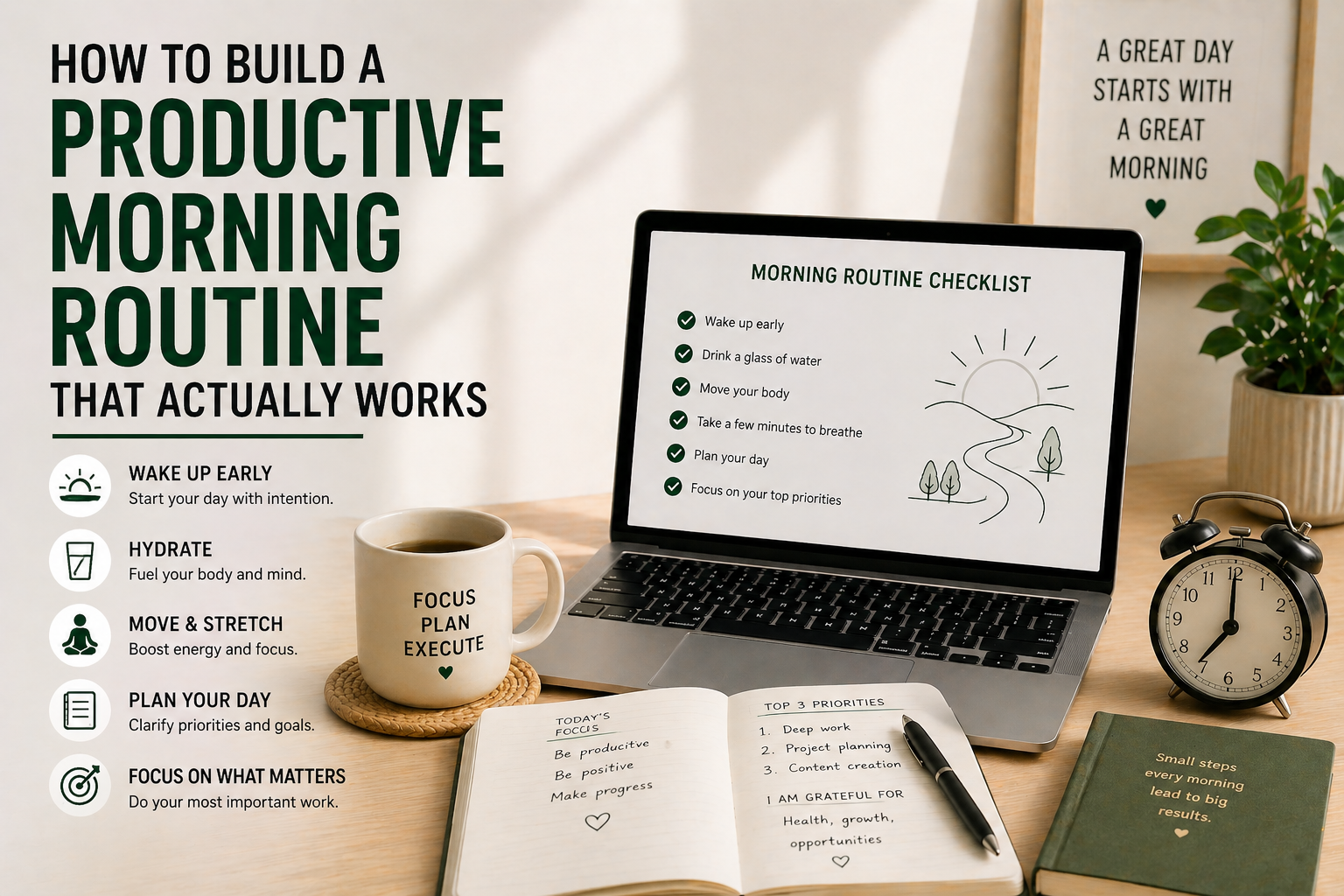
Most morning routine advice sounds like a lifestyle makeover: wake at 5am, cold shower, journal, meditate, exercise, all before breakfast. Then it falls apart in week two, and you feel you failed at mornings.
The problem is usually the size of the routine, not you. A routine that works is small enough to survive a bad night’s sleep. This guide shows how to build one from three parts, with a few sample routines, and says plainly what research can and can’t tell you about mornings.
Quick answer: A productive morning routine is a short, repeatable sequence that ends with you starting your most important task. Build it from three parts: an anchor (something you already do every morning), one to three small steps (a glass of water, a short walk, a two-line plan), and a first work task decided the night before. Start with fewer steps than you think you need.
Does a morning routine make you more productive?
We want to be straight about this: we didn’t find research showing that any particular morning routine, such as waking at 5am, boosts productivity. Many articles claim it does. We’ve removed those claims from this guide.
What research does support is about habits, and the sections below rely on it.
Planning when and where helps. “Implementation intentions” are if-then plans that link a situation to a response, such as “When I pour my coffee, I’ll write my top task.” A review of 94 studies (Gollwitzer and Sheeran, 2006) found they had a medium-to-large effect on goal attainment (d = .65) (National Cancer Institute summary). A morning routine is a chain of these plans.
Habits take longer than you’d think. In a study of 96 university students, the average time to reach a habit’s maximum automaticity was 66 days, and individuals ranged from 18 days to a predicted 254. Missing a single day had little impact on later progress (Lally et al., 2010, summarised by the British Psychological Society). So expect your routine to feel effortful for weeks, and don’t quit after one slip.
The three parts of a routine that lasts
These are our suggestions, built on the research above.
1. Pick an anchor
An anchor is something you already do every morning without thinking: turning off the alarm, making coffee, brushing your teeth. Attach your routine to it. “After I make coffee, I will…” works better than “In the morning, I will…” because the anchor is a clear trigger. Our guide to habit stacking covers this in more detail.
2. Choose one to three small steps
Pick steps you can do in 10 to 20 minutes in total. Good candidates:
- A glass of water
- Five minutes of movement or a short walk
- A quick look at your plan for the day (not your inbox)
- A few minutes of quiet: breathing, stretching, or a short mindfulness exercise
The steps matter less than doing them in the same order every day. If a step feels like a chore, swap it for something easier. Make each one tiny at first. Our two-minute rule guide explains how to shrink a habit until it’s easy to start.
3. End with a first work task
A routine that doesn’t lead to work is just a ritual. Choose your first task the evening before, as in our guide to planning your day the night before, so you don’t decide while your inbox is open. End your routine by starting it, even for ten minutes.
Three sample routines
These are illustrations to adapt, not a prescription.
| 10-minute routine | 30-minute routine | Parent or shift worker | |
|---|---|---|---|
| Anchor | Alarm off | Coffee made | First moment alone |
| Step 1 | Water | Water and stretch | Water |
| Step 2 | Read today’s top task | 10-minute walk | Two-line plan for the day |
| Step 3 | Read plan, no email | ||
| Ends with | 10 minutes on the main task | 25 minutes on the main task | Main task in the first free window |
If your mornings are crowded with school runs or caring, see morning routine for working moms. If you run your own business, morning routines that supercharge entrepreneurial productivity goes deeper.
What to leave out of a morning routine
- Your phone, at first. Checking email or social media before you start pulls your attention into other people’s priorities. Here’s how to stop doomscrolling in the morning.
- Steps you don’t actually want. If cold showers aren’t for you, skip them. A routine you resent won’t last.
- Copying someone’s 5am schedule. Their life isn’t yours. Start from the time you actually wake up.
How to start this week
- Tonight: write your first work task for tomorrow, and choose your anchor.
- Tomorrow: do one small step after your anchor, then start the task for 10 minutes.
- Days 3 to 7: add one more step only if the first feels easy.
- Day 8: ask what’s working. Cut anything you dread.
- Keep going for weeks, not days. If you miss a day, restart the next morning.
To track it, see our habit tracking guide.
Frequently asked questions
What is a productive morning routine? A short, repeatable set of steps that ends with you starting your most important task.
How long should a morning routine be? As short as it needs to be to survive a bad day. Ten to 30 minutes is a sensible range to try, but this is our suggestion rather than a research finding.
Do I need to wake up at 5am? No. We didn’t find research showing early waking itself improves productivity. Choose a time you can keep.
How long does it take to build a morning routine? It varies. In one study of 96 students, building a habit took anywhere from 18 to 254 days, with an average of 66.
What should I do if I miss a day? Restart the next morning. The same study found a single missed day had little impact on later progress.
Updated 19 October 2026: we merged our older morning routine posts into this guide and removed health and productivity claims we couldn’t source.
Sources
- National Cancer Institute: Implementation intentions
- British Psychological Society Research Digest on Lally et al. (2010)