
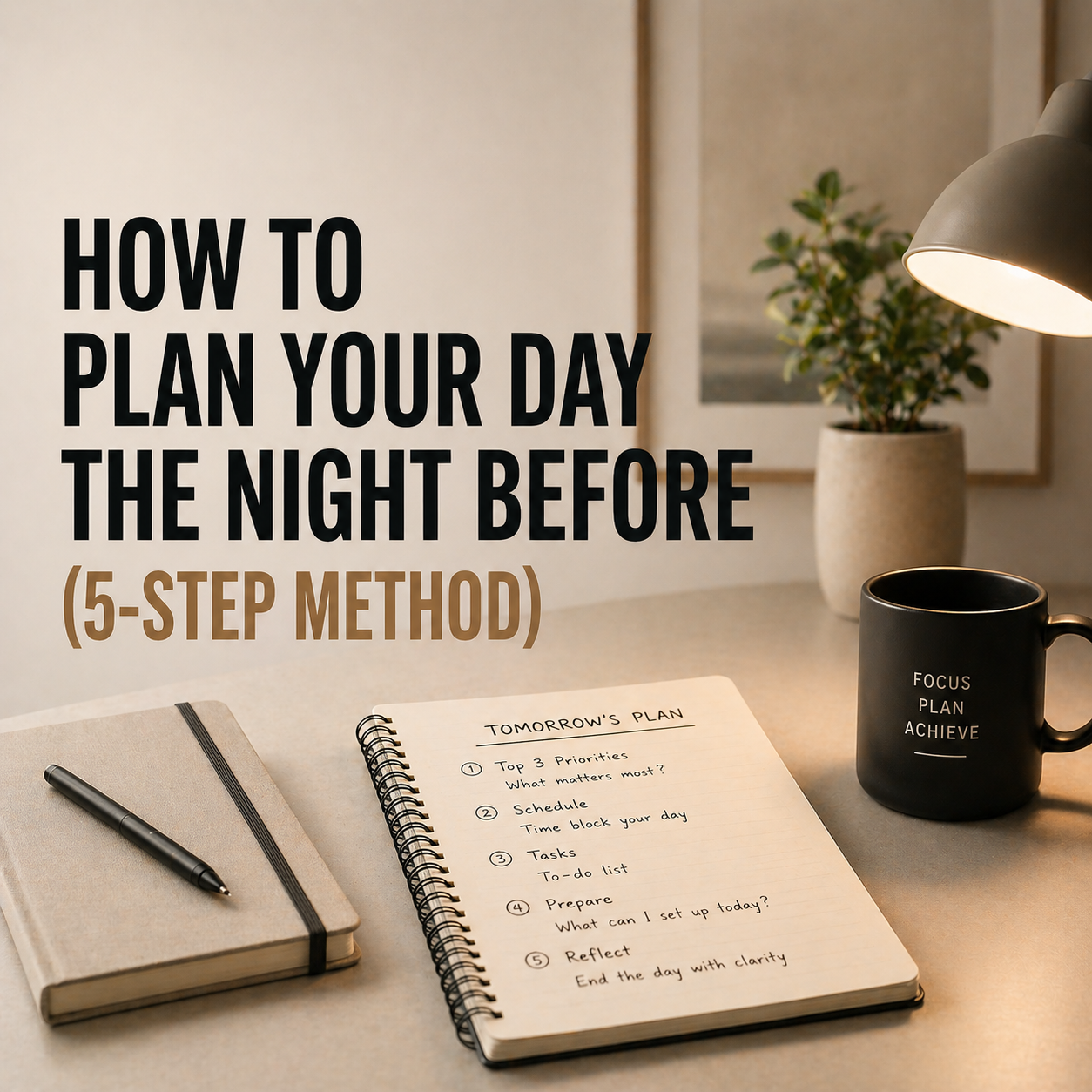
Quick answer: Planning your day the night before takes 10-15 minutes and follows five steps: review today, identify tomorrow’s top 3 priorities, time block them into your calendar, prepare your environment, and write a shutdown statement. This simple method saves 60-90 minutes the next day by eliminating the “what should I do first?” fog that wastes most people’s mornings.
Most productivity advice says “plan your day in the morning.” That’s backwards. By morning, your willpower is at its peak — spending it on planning instead of doing is a waste. The night before, your brain is in evaluation mode (not execution mode), which makes it better at sorting, prioritizing, and deciding. Plan at night. Execute in the morning.
This guide gives you a specific 5-step method you can start tonight in under 15 minutes. No app required, no complex system, just a reliable routine that compounds over weeks.
Why Planning the Night Before Works Better Than Morning Planning
Three reasons most people don’t realise:
1. Your brain processes priorities while you sleep. When you review tomorrow’s tasks before bed, your subconscious works on them overnight. This is well-documented in sleep research — the brain consolidates decisions and problem-solves during deep sleep. You’ve probably experienced waking up with sudden clarity about a problem you couldn’t solve the night before. Night planning triggers this process intentionally.
2. Morning decision fatigue is real. Every small decision — what to wear, what to eat, what to work on first — draws from a limited daily pool. If your first 30 morning minutes are spent deciding what to do, you’ve burned your best energy on administration. Night planning eliminates that entirely. You wake up, look at the plan, and start.
3. Anxiety reduction. Open loops — tasks you know you need to do but haven’t written down — create low-grade anxiety that disrupts sleep. Writing tomorrow’s plan closes those loops. Research on the “Zeigarnik Effect” shows that simply writing down unfinished tasks reduces their cognitive burden, even before you’ve started them.
This is why night planning pairs so powerfully with a productive morning routine — the planning happens at night, the execution happens in the morning, and neither wastes the other’s time.
The 5-Step Night-Before Planning Method
This method takes 10-15 minutes. Do it at the same time each evening — ideally 30-60 minutes before bed, after dinner, not while watching television. Consistency matters more than perfection.
Step 1: Review Today (3 minutes)
Before planning tomorrow, close today. Open your task list, calendar, or journal and answer three questions:
- What did I complete today? (Acknowledge your wins — even small ones)
- What didn’t get done? (No judgment — just move it to tomorrow or delete it)
- Did anything unexpected happen that changes my priorities?
This step takes 2-3 minutes and prevents yesterday’s incomplete tasks from silently cluttering tomorrow’s plan. If a task has been pushed three days in a row, it either needs to be scheduled with protected time or deleted entirely — it’s clearly not a real priority.
Step 2: Identify Tomorrow’s Top 3 Priorities (3 minutes)
Write down the three most important things you need to accomplish tomorrow. Not the most urgent — the most important. These are your “Big 3.” If tomorrow went perfectly and you only finished these three things, you’d still call it a productive day.
Rules for the Big 3:
- Maximum of 3. Not 5, not 7. Three forces you to prioritize ruthlessly.
- Each must be specific enough to start working on without further clarification. “Work on project” is too vague. “Write introduction section of project proposal” is actionable.
- At least one must be a Quadrant 2 task (important but not urgent). Otherwise you’re just reacting to other people’s priorities.
If you’re not sure which tasks qualify as your Big 3, use the Eisenhower Matrix to sort your task list first. Q1 and Q2 tasks are your candidates.
Step 3: Time Block Your Big 3 Into Tomorrow’s Calendar (4 minutes)
Open your calendar. For each of your Big 3 tasks, block a specific time window. Not “sometime tomorrow” — a specific slot with a start and end time.
- Put your most important or most cognitively demanding task in your peak energy window (for most people, that’s the first 2-3 hours of the workday)
- Estimate how long each task will take, then add a 25% buffer (things always take longer than you think)
- Leave at least 15-30% of the day unscheduled for interruptions, overflow, and real life
- Don’t block every minute — blocked days that leave no breathing room collapse by 11 AM
This step transforms your to-do list into a time commitment. “Write proposal introduction” is a wish. “Write proposal introduction, 9:00-10:30 AM” is a plan. For the calendar app that makes this easiest, see our best calendar apps for time blocking guide.
For more on time blocking mechanics, our detailed time blocking for entrepreneurs guide covers the full system.
Step 4: Prepare Your Environment (3 minutes)
This is the step most planning methods miss — and it’s the one that makes the biggest difference in actually executing your plan the next morning.
Physical preparation eliminates friction between your plan and your action. The smaller the gap between waking up and starting, the more likely you actually follow through.
- Desk preparation: Clear your workspace. Close all browser tabs. Open only the document or tool you need for Task #1. Your desk should look like someone who’s about to start your most important task, not someone who just finished a random day.
- Phone preparation: Set your phone to Do Not Disturb for the first 2 hours of tomorrow. Pre-load focus music or white noise if you use it. Charge overnight away from your bed.
- Morning prep: Lay out clothes. Prep breakfast ingredients if applicable. Set the coffee machine. The goal: zero morning decisions that aren’t “start working on Task #1.”
This step sounds trivial. It isn’t. The difference between a desk ready for your top priority and a desk cluttered with yesterday’s chaos is often the difference between a focused morning and a reactive one.
Step 5: Write a Shutdown Statement (1 minute)
End with a deliberate shutdown. Cal Newport calls this the “shutdown ritual” — a short phrase or checklist that signals to your brain that work is done for the day. Without it, your mind keeps running work loops that disrupt sleep and rest.
Your shutdown statement can be as simple as writing or saying: “I’ve reviewed today. Tomorrow’s plan is set. I am done for today.” Some people prefer a written line in their journal. Others close their laptop, say the phrase out loud, and move on.
The specific words don’t matter. The boundary does. After the shutdown statement, you don’t check email, you don’t review the plan again, you don’t add “just one more thing.” The plan is locked. Tomorrow morning handles execution.
The Complete Night-Before Planning Template
Here’s everything above in one template you can copy into a journal, notebook, or notes app:
| Step | Action | Time |
|---|---|---|
| 1. Review Today | What got done? What didn’t? Anything change? | 3 min |
| 2. Big 3 | Write 3 most important tasks for tomorrow | 3 min |
| 3. Time Block | Place Big 3 into specific calendar slots | 4 min |
| 4. Prep Environment | Clear desk, prep phone, set up morning | 3 min |
| 5. Shutdown | Say or write your shutdown statement | 1 min |
Total time: 14 minutes. Time saved tomorrow: 60-90 minutes (from eliminating morning planning, decision fatigue, and startup friction).
What to Do When the Plan Breaks (And It Will)
No plan survives the morning fully intact. Meetings get added. Kids get sick. Urgent requests land in your inbox. The night-before plan isn’t a rigid contract — it’s a starting position. Here’s how to handle common breakdowns:
If a new urgent task appears: Compare it against your Big 3 using the Eisenhower Matrix. Is the new task genuinely more important than what you planned? If yes, swap. If no, it waits.
If your Big 3 takes longer than expected: Finish Task #1 even if it runs over. Then reassess — you may only get 2 of your 3 done today. That’s still a win. Don’t rush all three poorly to check boxes.
If you wake up in a different mood than expected: Keep the plan. Mood follows action, not the other way around. Start Task #1 for just 5 minutes — if after 5 minutes you truly can’t continue, switch. But most of the time, the 5-minute start carries you through.
If the whole day goes sideways: Don’t abandon the system. Tonight, run the 5-step method again. Consistency across weeks matters infinitely more than perfection on any single day.
Night-Before Planning by Persona
For Entrepreneurs
Your Big 3 should always include at least one revenue-generating or strategic task (Q2 work). Without this rule, your day fills with operational firefighting. Put the strategic task in your first morning block before anyone else is awake or pinging you. See our 10 productivity tips for entrepreneurs for more on structuring your entrepreneurial day.
For Students
Your Big 3 should map to specific study tasks, not vague subjects. “Study biology” is not a task. “Complete biology chapters 7-8 review questions” is. Time block study sessions in 50-minute blocks using the Pomodoro Technique, and use Step 4 to prepare your desk with only the materials for tomorrow’s first study session.
For Remote Workers
Your night plan must include when to START and STOP work. Remote work without boundaries expands to fill the entire day. Write your start time, end time, and Big 3 — then use Step 4 to physically close your laptop at your planned stop time so it’s already “away” when you wake up and walk to your desk.
For Parents
Your Big 3 likely includes one household task, one personal goal, and one work task. That’s fine — night planning works for life, not just work. Step 4 matters most for parents: prep the kids’ lunches, set out clothes for yourself and the children, and reduce morning chaos as much as possible. Every decision removed at night saves five minutes of morning stress.
Tools That Support Night-Before Planning
You don’t need any tool — a paper notebook works perfectly. But if you want digital support, here are the best options based on what we’ve tested:
- For the Big 3 list: Todoist, TickTick, or Microsoft To Do (all free — see our best free organisation apps guide)
- For time blocking Step 3: Google Calendar, Notion Calendar, or Sunsama (see our best calendar apps for time blocking guide)
- For focus during execution: Forest or Focus Keeper (see our best free Pomodoro timer apps guide)
But seriously — start with a paper notebook and a pen. Add digital tools only when you’ve built the habit (typically after 2-3 weeks of consistent nightly planning).
Common Night-Before Planning Mistakes
Five mistakes kill this habit for most people:
- Planning too many tasks. Three priorities, not ten. If you write 10 things, you’ll wake up overwhelmed. Three keeps it achievable.
- Being vague. “Work on presentation” fails because it gives you nothing to start on. “Write slides 1-5 of client presentation” succeeds because the next action is obvious.
- Skipping the environment prep. A planned day with a cluttered desk defeats itself. Step 4 isn’t optional — it’s the bridge between planning and doing.
- Doing it right before bed. If you plan at 11:30 PM while exhausted, you’ll write garbage priorities. Plan 30-60 minutes before bed while you still have some energy.
- Revising the plan in the morning. Morning you wants to change the plan because morning you doesn’t feel like doing Hard Task #1. Don’t let morning you negotiate. Follow the plan night-you made with a clear head.
For more on building the underlying mindset that makes planning routines stick, our mindfulness habits of highly productive people guide covers the consistency foundation any routine depends on.
Frequently Asked Questions
Should I plan my day the night before or in the morning?
The night before is better for most people. Evening planning takes advantage of your brain’s reflective mode, reduces morning decision fatigue, and allows your subconscious to process priorities overnight during sleep. Morning planning wastes peak willpower on administration instead of execution. Plan at night, execute in the morning.
How long does night-before planning take?
The 5-step method takes 10-15 minutes once you’ve practised it a few times. The first few nights might take 20 minutes as you get used to the format. Within a week, it becomes a 10-minute routine that saves 60-90 minutes the following morning.
What should I write in my nightly plan?
Focus on three things: your Big 3 priorities for tomorrow (the three most important tasks), the specific time blocks when you’ll do them, and any environment preparation needed (desk setup, clothes, meals). Keep it simple — a 3-line plan you actually follow beats a 30-line plan you ignore.
What if my plan doesn’t work the next day?
That’s normal and expected. The plan is a starting position, not a rigid contract. If something urgent disrupts your plan, assess whether it’s genuinely more important than your Big 3. If yes, adapt. If no, it waits. The key is running the 5-step method again tonight — consistency across weeks matters more than any single day.
Can I plan my day the night before using my phone?
Yes, but be careful. Using a phone for planning risks getting pulled into social media, email, or notifications that disrupt your pre-sleep wind-down. If you plan on your phone, use a specific app (Todoist, TickTick, or a plain notes app), complete the 5 steps, then put the phone away. A paper notebook avoids this risk entirely.
What is the “Big 3” method?
The Big 3 method means choosing only three priority tasks for tomorrow — the three things that, if completed, would make the day a success regardless of what else happens. Limiting to three forces ruthless prioritization and prevents the overwhelm that comes from a 15-item to-do list. At least one of your Big 3 should be important-but-not-urgent (Quadrant 2) work.
Does night-before planning help with anxiety?
For many people, yes. Research on the Zeigarnik Effect shows that unfinished tasks create cognitive loops that generate low-grade anxiety. Writing tomorrow’s plan closes those loops by moving tasks from your working memory to an external system. Many users report falling asleep faster and sleeping more restfully after establishing a nightly planning habit.
Final Take — Start Tonight
Don’t start this method “on Monday.” Start tonight. Open a notebook or notes app, run through all five steps, and set yourself up for tomorrow morning. The whole thing takes 14 minutes and will save you an hour tomorrow.
After one week, you’ll notice something shift: mornings stop feeling chaotic. You walk to your desk knowing exactly what to do, in what order, with everything already in place. That’s not motivation — it’s preparation. And preparation, done consistently the night before, beats motivation every single time.
Related Reading
- How to Build a Productive Morning Routine
- Eisenhower Matrix: 12 Real Examples
- Time Blocking for Entrepreneurs
- 12 Best Calendar Apps for Time Blocking
- 12 Best Free Pomodoro Timer Apps
- Mindfulness Habits of Highly Productive People