
Everything on your list feels like it matters, so you do whatever is loudest. By Friday the loud things are done, and the quiet one that would have moved your work forward hasn’t been touched.
The Eisenhower Matrix is a way to break that pattern. You sort each task by two questions, “Is it urgent?” and “Is it important?”, and the answer tells you what to do with it. This guide explains where the idea comes from, how the four boxes work, and gives you worked examples for a freelancer, a manager and a student.
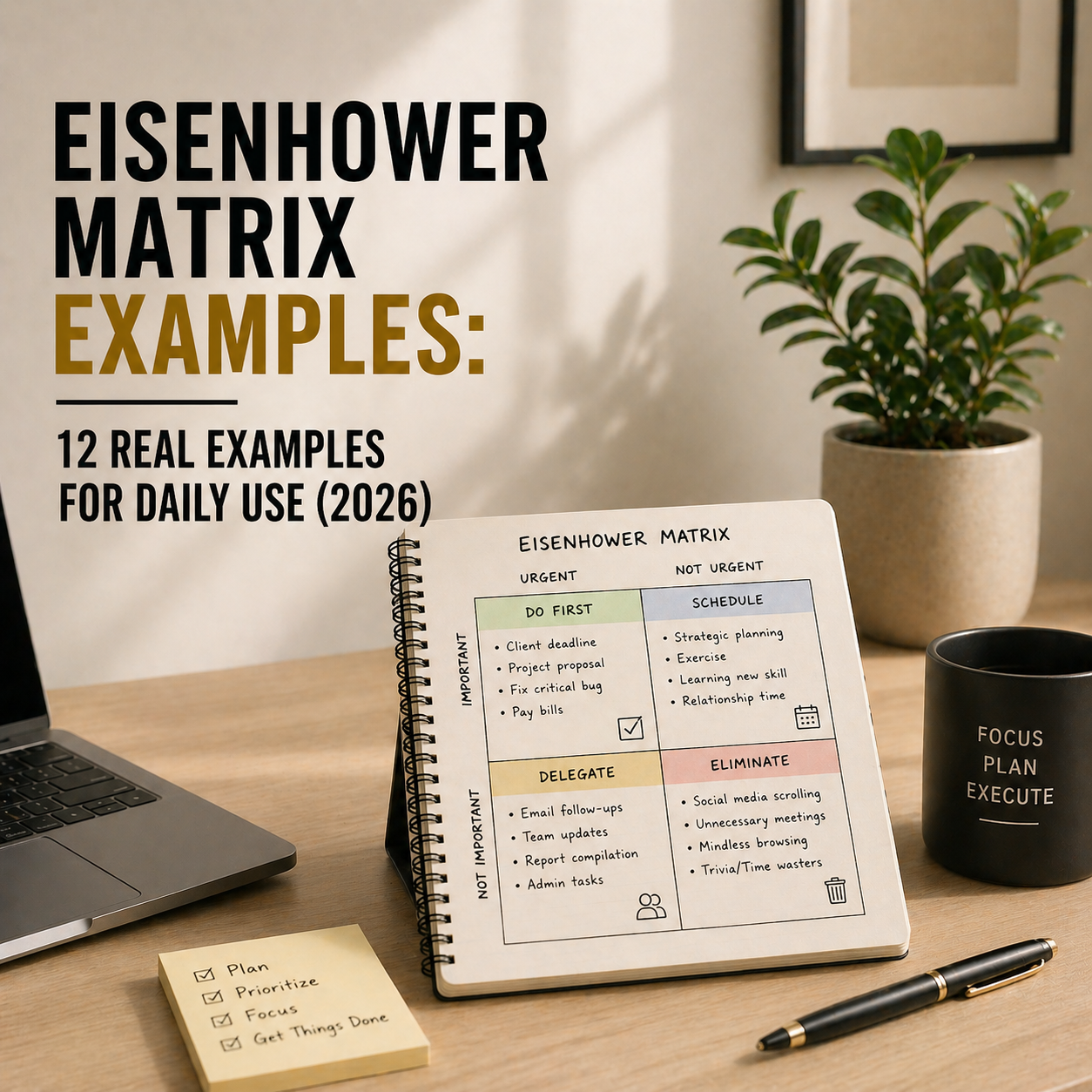
Quick answer: The Eisenhower Matrix is a 2×2 grid that sorts tasks by urgency and importance. Urgent and important: do it now. Important but not urgent: schedule it. Urgent but not important: delegate it or limit it. Neither: drop it. The skill is in being honest about the word “important.”
Where the Eisenhower Matrix comes from
The idea comes from a speech. On 19 August 1954, President Dwight D. Eisenhower told the Second Assembly of the World Council of Churches in Evanston, Illinois: “I have two kinds of problems, the urgent and the important. The urgent are not important, and the important are never urgent.” He said he was repeating a remark from a former college president (Quote Investigator).
Two things are worth knowing, because many articles get them wrong:
- The popular wording, “what is important is seldom urgent and what is urgent is seldom important,” doesn’t appear in that 1954 transcript. It shows up in later secondhand accounts, according to Quote Investigator.
- Eisenhower didn’t draw a matrix. Quote Investigator’s page says it isn’t known whether he used the technique at all. The four-box version is usually credited to Stephen Covey’s The 7 Habits of Highly Effective People (1989), which built its own time management matrix on the quote (Andy Eklund).
So “Eisenhower Matrix” is a name that stuck, not a method he published. The idea behind it still holds up.
The four boxes
| Urgent | Not urgent | |
|---|---|---|
| Important | 1. Do now. A client emergency, a deadline today | 2. Schedule. Planning, skill-building, exercise, relationships |
| Not important | 3. Delegate or limit. Many emails, some meetings, other people’s requests | 4. Drop. Mindless scrolling, busywork |
Two definitions keep the grid honest:
- Urgent means it needs attention soon, usually because someone is waiting or a deadline is close.
- Important means it moves you toward something you actually care about, such as a goal, a key relationship or your health.
The one that matters most is box 2. Those tasks have no deadline pushing them, so they get skipped until they become box 1 emergencies. The matrix is only useful if you put box 2 tasks into your calendar. Our guide to time blocking shows how.
Eisenhower Matrix examples
These are illustrations of how the sorting works, not research findings. Your boxes will differ, because “important” depends on your goals.
A freelance designer
| Box | Task |
|---|---|
| 1. Do now | Fix the typo in the logo file a client is about to print |
| 2. Schedule | Update the portfolio; write the pricing page; plan next month’s outreach |
| 3. Delegate or limit | Chasing small invoices (automate reminders); replying to every email instantly |
| 4. Drop | Redesigning your own business card for the fifth time |
A team manager
| Box | Task |
|---|---|
| 1. Do now | A production problem blocking the whole team |
| 2. Schedule | One-to-ones; coaching a new hire; writing next quarter’s plan |
| 3. Delegate or limit | Approving routine expenses; status meetings you could replace with a short message |
| 4. Drop | Reformatting a report nobody asked for |
A student
| Box | Task |
|---|---|
| 1. Do now | An essay due tomorrow |
| 2. Schedule | Revising for an exam in three weeks; sleep; exercise |
| 3. Delegate or limit | Group chat messages; low-stakes admin forms |
| 4. Drop | Scrolling between study sessions |
How to use the matrix in 15 minutes
- List everything. Write every open task on one page. Don’t sort yet.
- Mark urgency first. Put a “U” next to anything with a real deadline or someone waiting. “Real” means a consequence if it slips.
- Mark importance second. Ask: “If I did this and nothing else this week, would I be glad?” That’s an “I.”
- Place each task in a box. U and I is box 1. I only is box 2. U only is box 3. Neither is box 4.
- Act on the boxes in order. Do box 1 now. Put dates and times on box 2 in your calendar. Hand off or batch box 3. Delete box 4, or accept that you chose to do it.
- Repeat weekly. A weekly review is the natural slot.
Common mistakes
- Calling everything urgent. If 80% of your list is in box 1, the real problem is planning, or other people’s urgency becoming yours.
- Leaving box 2 in the matrix. A task only counts as “scheduled” if it has a time on your calendar.
- Treating box 3 as important because someone asked. A request is urgent for the asker. Whether it’s important to you is a separate question.
- Using it for tiny tasks. The matrix helps with choosing between meaningful tasks. For quick items, use the two-minute rule.
- Over-engineering it. A sheet of paper and four boxes is enough. If you want an app, see our free organisation apps.
When the matrix isn’t enough
The matrix tells you which tasks to do first. It doesn’t say how long each takes, how to stay on one without distraction, or when to do it. For those, pair it with a Pomodoro timer for focus and time blocking for scheduling. If you’re an entrepreneur choosing between several important things, see how to prioritize tasks as an entrepreneur.
Frequently asked questions
What is the Eisenhower Matrix? A prioritising grid with four boxes: urgent and important, important but not urgent, urgent but not important, and neither. Each box has a default action: do, schedule, delegate or drop.
Did Eisenhower invent the Eisenhower Matrix? No evidence we found says he did. He quoted a remark about urgent and important problems in a 1954 speech. The four-box grid is usually credited to Stephen Covey’s 1989 book.
What goes in the “important but not urgent” box? Work that builds your future but has no deadline: planning, learning, exercise, relationships. This is the box most people neglect, so give it calendar time.
How do I decide what’s important? Ask whether the task moves you towards a goal you’d name out loud. If you can’t say which goal, it may belong in box 3 or 4.
Can I use it every day? Yes. Many people do a quick version in the morning and a fuller one in a weekly review.
Updated 19 October 2026: we merged our older Eisenhower Matrix posts into this single guide, corrected the origin story, and added worked examples.
Sources
- Quote Investigator: What Is Important Is Seldom Urgent and What Is Urgent Is Seldom Important
- Andy Eklund: Time management matrix