
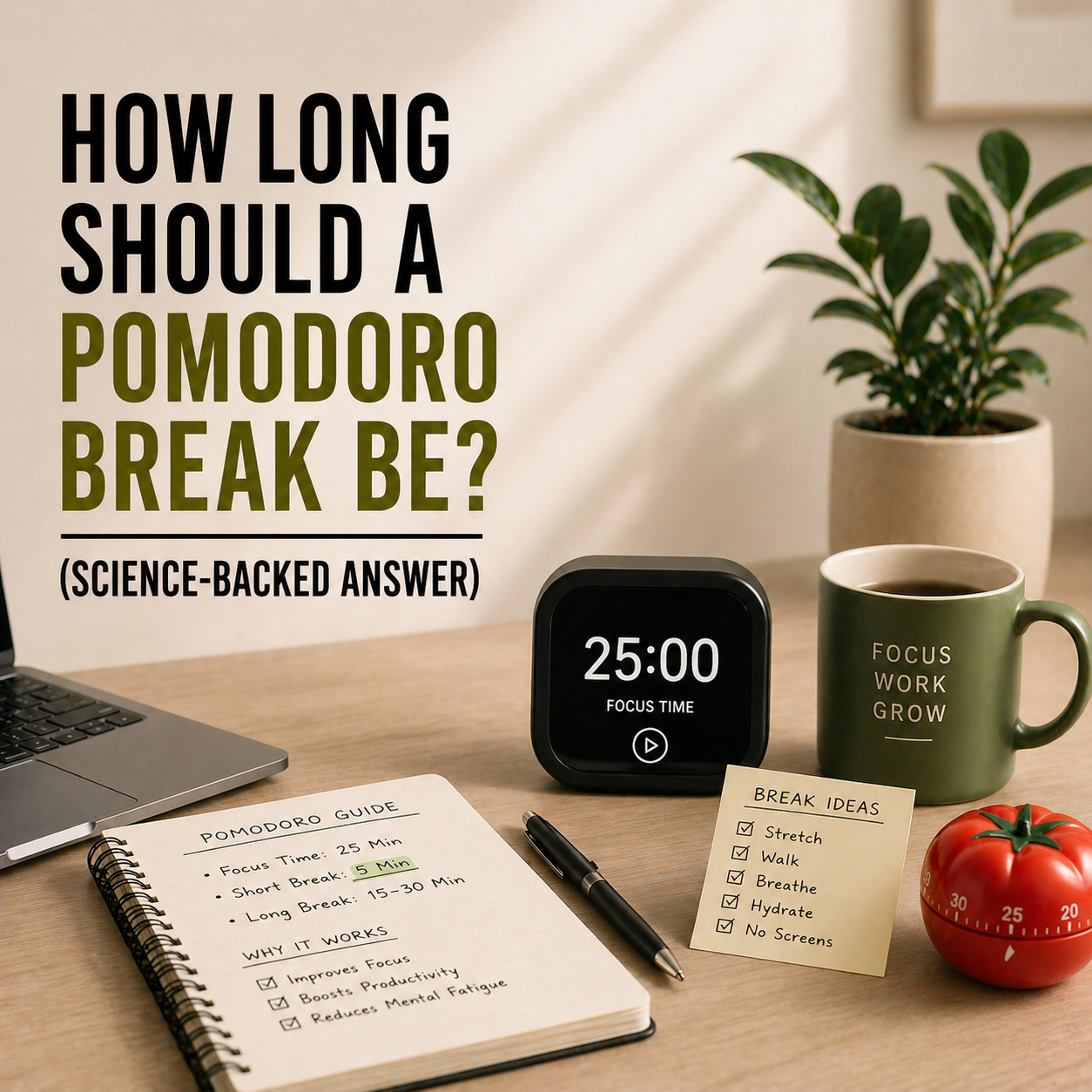
Quick answer: A standard Pomodoro break is 5 minutes after each 25-minute work session, with a longer 15-30 minute break after every 4 completed Pomodoros. However, the optimal break length depends on the type of work — creative tasks often benefit from longer 10-15 minute breaks, while simple tasks do well with shorter 3-5 minute pauses. The break length matters less than taking breaks consistently.
That’s the 30-second answer. But the real question is: should you follow the standard 5-minute rule, or adjust it for your work style? This guide covers what the original Pomodoro Technique says, what cognitive science actually shows, how to adjust break length based on your work type, and the break activities that genuinely restore focus versus the ones that drain it further.
The Standard Pomodoro Break Lengths
The original Pomodoro Technique, created by Francesco Cirillo in the late 1980s, specifies two types of breaks:
- Short break — 5 minutes after each 25-minute Pomodoro
- Long break — 15 to 30 minutes after every 4 completed Pomodoros (2 hours of work)
A full cycle therefore looks like this: 25 minutes work → 5 min break → 25 min work → 5 min break → 25 min work → 5 min break → 25 min work → 15-30 min break. Total time: roughly 2 hours 15-30 minutes, which contains 100 minutes of focused work and 30-45 minutes of structured rest.
These numbers aren’t arbitrary. Cirillo tested different work/rest ratios and settled on 25/5 because it was long enough to accomplish meaningful work but short enough that most people could hold focus throughout. Longer breaks after every 4 sessions addressed the cognitive fatigue that accumulated across a full cycle.
For the full walkthrough of how the technique works, see our guide on how to boost productivity with the Pomodoro Technique.
What Science Says About Pomodoro Break Length
The 25/5 ratio in the Pomodoro Technique roughly aligns with research on “ultradian rhythms” — the natural 90-120 minute cycles of alertness and fatigue the human brain runs throughout the day. Within each cycle, attention peaks for 15-20 minutes, plateaus for another 20-30 minutes, then begins to decline.
Research on attention and recovery generally supports short, frequent breaks over long infrequent ones. A study by the DeskTime productivity tool (analysing 5+ million tracked work sessions) found that the most productive 10% of users worked for approximately 52 minutes, then rested for 17 minutes — a longer ratio than classic Pomodoro, but built on the same principle.
The key insight: break length matters less than break consistency. Taking any structured break significantly outperforms pushing through fatigue. The specific length is a tuning variable, not a rule.
When to Use a 5-Minute Break
A 5-minute break works best for:
- Quick-context tasks like email, admin work, or light writing where getting back into flow is easy
- Learning and memorisation where spacing is more important than deep rest
- Energetic times of day (morning, after exercise) when fatigue hasn’t accumulated
- The first 2-3 Pomodoros of a session, before cognitive fatigue sets in
Short breaks are also useful for ADHD brains that struggle with long pauses — a quick 5-minute break keeps momentum without giving the brain time to wander into distraction. Longer breaks often lead to “just one more thing” that turns 15 minutes into an hour lost.
When to Use a 10-15 Minute Break
Longer short breaks (10-15 minutes) work better for:
- Deep creative work — writing, designing, complex problem-solving — where the brain needs recovery time
- High-stakes cognitive tasks like coding architecture decisions or strategic planning
- Afternoon slumps when fatigue has accumulated and a quick reset isn’t enough
- Longer work sessions — if you’re doing 50-minute Pomodoros instead of 25, scale the break up to 10-12 minutes
The 50/10 ratio is popular among writers, developers, and designers for exactly this reason. Deep creative work has higher cognitive cost, so longer work sessions and longer breaks both make sense.
When to Use a 15-30 Minute Break
The long break after every 4 Pomodoros should be 15-30 minutes. Use the longer end (25-30 minutes) when:
- You’ve been working for 2+ hours on cognitively demanding tasks
- It’s around lunchtime and you actually need food and movement
- You’re switching project types (e.g., from deep work to meetings)
- You’re approaching the afternoon slump (typically 2-4 PM)
Shorter long breaks (15 minutes) work when you’re in momentum and don’t want to lose it. The 30-minute version is genuine recovery; the 15-minute version is structured punctuation between sprints.
Break Activities That Actually Restore Focus
What you do during the break matters as much as the break length. Research on attention recovery consistently shows that certain activities restore focus, while others drain it further.
Activities that restore focus
- Physical movement — stand up, walk around, stretch, do light bodyweight exercise
- Looking at nature — even a window view of trees or plants has measurable attention-restoring effects
- Hydration and breathing — drink water, take 5 slow deep breaths
- Daydreaming or mind-wandering — staring out a window, resting your eyes, letting your mind drift
- Short conversations with colleagues or family (not work-related)
Activities that drain focus further
- Scrolling social media — the rapid context-switching depletes the attention you just restored
- Checking email — opens new tasks and anxiety loops during what should be rest
- News sites — dopamine-driven content that makes returning to slow work feel punishing
- Short videos (TikTok, Reels, Shorts) — the fastest way to lose 15 minutes you planned to spend on a 5-minute break
- Work-related reading — defeats the purpose of a break
If you only make one change to how you take Pomodoro breaks, make it this: stay off your phone. The whole point of the break is to give your attention system a rest, and smartphones give it anything but.
For a deeper look at protecting focus, see our mindfulness habits of highly productive people.
Should You Skip Breaks If You’re “In the Zone”?
This is one of the most common questions about the Pomodoro Technique, and the answer is nuanced.
Cirillo’s original rule was strict: when the timer rings, you stop — flow state or not. The logic is that breaks prevent the fatigue you can’t yet feel, and pushing through flow usually leads to a crash an hour later.
In practice, most modern Pomodoro practitioners take a pragmatic approach: if you’re deep in flow at the 25-minute mark, note where you are, continue for another 10-15 minutes, and take a slightly longer break afterwards. The key is that the decision to continue is conscious, not automatic.
The one time you should never skip a break: the long 15-30 minute break after 4 Pomodoros. Your brain genuinely needs real recovery by that point, and pushing through consistently leads to the afternoon crash that kills the rest of your day.
Common Break-Length Mistakes
Three mistakes kill Pomodoro effectiveness more than any break length issue:
- Breaks that sprawl — a “5-minute break” that becomes 20 minutes of scrolling. Use a timer for the break too, not just the work session.
- Skipping the long break — the 15-30 minute rest is non-negotiable if you want to work productively all day. Skipping it trades afternoon output for 30 minutes of morning intensity.
- Taking breaks on your phone — undermines the entire recovery purpose. Keep your phone out of reach during breaks, especially the short ones.
The apps that help most people avoid these mistakes are covered in our guide to the best free Pomodoro timer apps — several include built-in break-length enforcement and phone lockout features.
Pomodoro Break Length by Work Type (Quick Reference)
| Work Type | Work Session | Short Break | Long Break (after 4) |
|---|---|---|---|
| Admin, email, light tasks | 25 min | 5 min | 15 min |
| Studying, memorisation | 25 min | 5 min | 15-20 min |
| Writing, editing | 25-50 min | 5-10 min | 20-25 min |
| Coding, complex problem-solving | 50 min | 10 min | 25-30 min |
| Creative design, strategy | 50-90 min | 10-15 min | 25-30 min |
| ADHD-friendly sessions | 15-25 min | 3-5 min | 15-20 min |
Use these as starting points, not rigid rules. Track your focus over a week, adjust by 5-minute increments, and settle on what genuinely works for the kind of work you do most often.
Frequently Asked Questions
How long is a standard Pomodoro break?
The standard Pomodoro break is 5 minutes after each 25-minute work session. After every 4 Pomodoros (roughly 2 hours of work), you take a longer break of 15 to 30 minutes. These lengths were established by Francesco Cirillo, the creator of the Pomodoro Technique, and remain the most widely used format today.
Is a 5-minute break long enough?
For most people doing light to moderate work, yes — 5 minutes is enough to reset attention without losing momentum. For deep creative work like writing, coding, or design, a 10-minute break often works better. The key is that 5 minutes only works if you actually rest — if you spend it scrolling your phone, any break length will feel insufficient.
Can I take longer Pomodoro breaks?
Yes. Many productivity experts recommend the 50/10 ratio (50 minutes work, 10 minutes break) for deep creative work. The DeskTime research found the most productive people work for 52 minutes and rest for 17 minutes. Adjust the ratio based on your work type — just keep it consistent so your brain adapts.
Should I skip a break if I’m in the zone?
The original Pomodoro rule says no — stop when the timer rings, even in flow state. In practice, most modern users take a pragmatic approach: continue for 10-15 minutes if you’re deep in flow, then take a slightly longer break. The one break you should never skip is the 15-30 minute long break after 4 Pomodoros — your brain needs real recovery by then.
What should I do during a Pomodoro break?
Best options include standing up, stretching, walking, drinking water, looking out a window, or having a short non-work conversation. Avoid scrolling social media, checking email, watching short videos, or reading news — these drain attention further instead of restoring it. The goal is genuine rest, not a different kind of stimulation.
How long should a Pomodoro break be for ADHD?
For ADHD brains, shorter breaks (3-5 minutes) often work better than longer ones because longer breaks give time for the brain to wander into distraction and struggle to return. Keep breaks short and structured — set a timer for the break itself, not just the work session — and avoid screens entirely during breaks.
What is the long break in Pomodoro and when do you take it?
The long break is a 15-30 minute rest taken after every 4 completed Pomodoros — roughly every 2 hours of work. Its purpose is to address the cognitive fatigue that accumulates across multiple short cycles. Use this break for food, a walk, or something genuinely restorative — not another email check.
Final Take — How to Set Your Pomodoro Break Length
Start with the standard: 5-minute short breaks and 15-30 minute long breaks after every 4 Pomodoros. Try it for a full week on the kind of work you do most often. Pay attention to how you feel at the end of each break — restored, neutral, or still tired?
If short breaks feel rushed, extend them to 7-10 minutes. If long breaks leave you sluggish, shorten them to 20 minutes. If you finish the day depleted regardless of break length, it’s usually not the break — it’s what you’re doing during the break that needs to change.
The right Pomodoro break length is the one that makes the next Pomodoro easier to start. That’s the only metric that matters.
Related Reading
- How to Boost Productivity with the Pomodoro Technique
- 12 Best Free Pomodoro Timer Apps
- Time Blocking for Entrepreneurs
- Time Blocking vs Time Boxing: Key Differences
- Mindfulness Habits of Highly Productive People
- 5 Time Management Hacks for Entrepreneurs